
Whilst offering great holidays, good value and knowledgeable advisors, sometimes travel agencies can still fail to secure business. People may not even be aware of an agency, responses can be late and those seeking quotes can frequently then fail to progress to booking. Appropriate technology can assist with each part of a travel agencies’ marketing. It can therefore enhance awareness generation via search engines, share holidays on social media, analyse web traffic and control both communication and further contact with people. Travel agencies however do not require vast numbers of technologies. Rather they should utilise a sensible mix of technology that seamlessly links marketing, communication and sales.
Customers consider many factors when researching their holiday. These include location of the holiday, hotel, activities, cost and additional elements. Marketing can used to engage with customers at each stage of a customer’s research and also to continue to interact with them post-enquiry.
Whilst researching for a family break to Dubai, a customer may initially find a travel agency via a Google search. They can then investigate the packages that the agency sells and further questions can be raised via WhatsApp. A quotation can then be obtained. Should the travel agency be unable to monitor and effectively respond to this customer’s enquiry, they risk losing out on business.
Whilst digital marketing for travel agencies should aim to generate web visitors, it should also seek to develop a system which progresses customers from awareness, to enquiry and then onto booking.
Key areas of tools available for travel agencies include; SEO, social media, advertising, CRM, communication and online booking.
SEO tools help travel agencies understand what potential travellers search for and how their website performs in search results. Using the right tools is an important part of SEO for travel agencies, helping them identify relevant keywords and improve their online visibility.
Useful tools: Google Search Console, Semrush and Ahrefs.
Google Search Console shows the queries generating impressions and clicks, helping agencies identify pages that need improvement. Semrush and Ahrefs offer keyword research and competitor analysis features that can help uncover destination-related content opportunities.
Practical use: An agency selling Bali packages may discover that travellers search for honeymoon packages, family holidays and budget itineraries. It can then create separate pages addressing those needs rather than relying on one general destination page
These tools support long-term organic traffic growth and reduce dependence on advertising alone.
Travel agencies can use social media tools to develop, design and post content. Social Media Marketing Services for Travel Agencies can ensure regular posting and also be used to market a range of travel products. Travellers can engage with content to learn more about various holidays.
Meta Business Suite and Canva are good tools for this purpose. Meta Business Suite can be used for managing both Facebook and Instagram content and Canva provides functionality for designing marketing and design material including holiday content and advertising.
Travel agencies wishing to market a winter holiday to Kashmir can produce content showing the snow, hotels and attractions along with package details. In addition, pre-arranging content ensures that posting continues at a steady rate even at busy times of year.
Whilst using social media, it is most effective to provide travellers with valuable information, rather than continually place emphasis on price. Developing a good social media content strategy can increase engagement and encourage travellers to enquire about holidays. This can therefore enhance a travel agency’s social media marketing.
Advertising tools enable travel agencies to target individuals seeking holidays or those with an interest in particular destinations. Travel agencies can effectively develop, target and control expenditure on advertising via Paid Advertisement Management.
Google Ads and Meta Ads Manager are good advertising tools. Google Ads can serve adverts in response to relevant search terms and Meta Ads Manager can be used to advertise videos, special deals and holidays to specific target groups.
Travel agencies can set up an advertising campaign for a summer European holiday and use this to drive traffic to a bespoke web page providing holiday detail such as holiday dates, what is included and an enquiry form.
Whilst analysing advertising effectiveness it is crucial to analyse not just click-through rates but also resulting enquiry and booking data. This assists travel agencies to recognise which adverts successfully result in enquiries and then in turn, bookings.
CRM tools allow travel agencies to hold customer data and to control the enquiry, lead allocation and subsequent follow up processes. Selecting an appropriate travel CRM can aid a travel agency’s control of its sales process and customer and booking related communications.
HubSpot CRM and Zoho CRM are good CRMs.
As travellers can usually enquire in a variety of ways, a CRM is a good way of centralising customer and sales data. Travel agencies can then recognise which traveller enquires are new, require quotation, are in follow up or have been sold. Best travel CRM can assist travel agencies in controlling leads and recognising all sales prospects.
If for example, a traveller enquires about a 4 person Singapore holiday, a consultant will enter information regarding the traveller’s budget, travel dates and requirements. Should the traveller fail to respond to a quotation, the CRM will alert the consultant to carry out follow up action.
This standardises lead handling and also enables travel agencies to recognise where within this process enquires may be becoming lost, so as to minimise lost sales potential.
Beyond the initial point of contact, WhatsApp and email can both be used by travel agencies to continue communication with travellers.
WhatsApp Business, Mailchimp and Brevo are good for this. WhatsApp Business is good for communicating quotations, holiday information and itineraries. Email systems are preferable for communicating newsletters, destination and seasonal promotional information and for continuing to engage with previous travellers.
For instance, if a traveller initially enquires about a family holiday but does not book right away, a consultant can email the traveller their quotation via WhatsApp. They will also note within the CRM when follow up action takes place. Subsequently, if the traveller has agreed to receive marketing emails, they can then be sent suitable holiday promotion information.
The traveller must receive pertinent information based upon their interests. Constantly emailing travellers with generic marketing information is not as effective.
Travel agency booking and itinerary systems can be utilised to further develop sales into actual bookings.
Depending on the system, facilities may exist for;
When travellers book a holiday to Thailand for example, a travel agency must arrange flights, hotel stays, transportation and excursions, alongside controlling payment. Rather than having to refer to various spreadsheets and communications, a travel agency can use booking software to effectively control all of these elements.
AI can be used by travel agencies to easily automate elements of their marketing. Within the tourism sector, AI is proving to be an effective tool that helps to enhance and streamline services for customers, including content production, communication and even planning, without necessarily increasing staff workloads.ChatGPT, Canva AI and chatbots are just some examples of technologies that can be used to:
A consultant could utilise AI to produce a preliminary version of a 5 day family holiday plan for a child-friendly break in Dubai. They can then research and verify details concerning points of interest, opening hours, costs, transport links and appropriateness, and onward transmit the holiday plan.
The choice between free and paid tools depends on the agency’s workload, marketing objectives and the limitations it encounters.
Free tools | Paid tools |
Suitable for agencies starting out | Useful for agencies with growing marketing activity |
Cover basic tracking, content and communication | May offer advanced reporting and automation |
Usually have usage, feature or account limits | Often give more features, capacity or integrations |
Good for testing marketing channels | Useful when marketing processes need to scale |
A small business can benefit from;
For instance, HubSpot has a basic CRM which allows for contact and deal management – terms and facilities may however differ between accounts.
Initially, implement tools that address specific needs. Only progress to further tools when you require added functionality that is not currently available. This may include auto communication features, additional capacity, enhanced reporting facilities or the ability to integrate marketing tools.
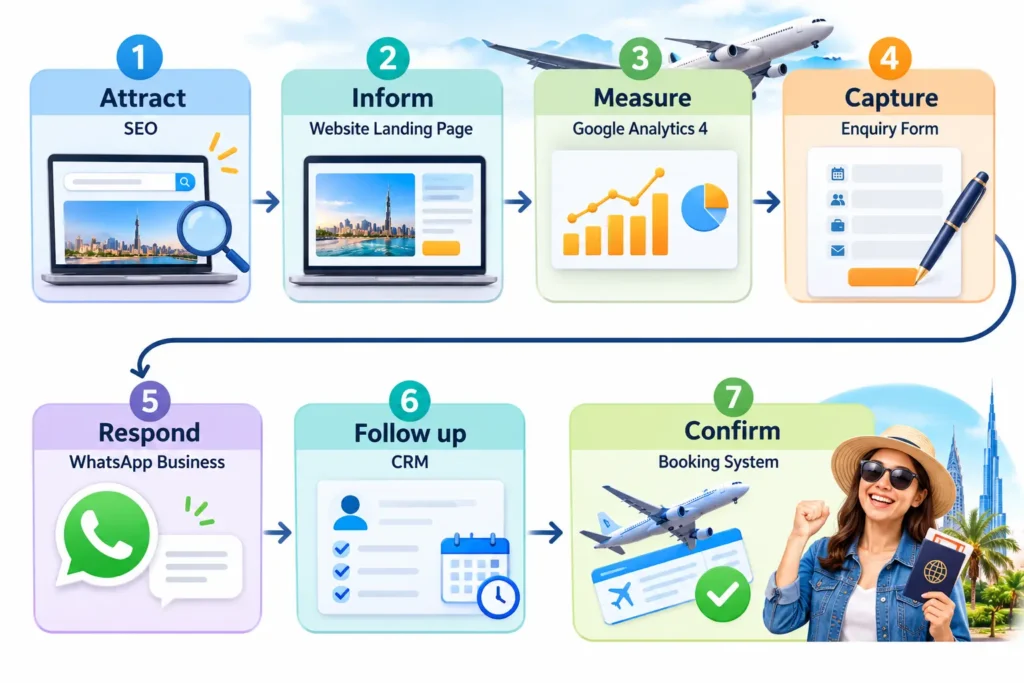
Marketing is an effective way to identify the correct market, respond to customer queries and then transform business leads into reservations. As your business develops, appropriate marketing, technology and automated solutions can improve and quantify these functions. Skybook Global assists travel businesses to improve their digital capabilities and marketing and provide a more organised route for business development. The correct digital strategy can therefore allow your business to effectively utilise its marketing to generate quality leads and drive sustainable business progression.
Adding {{itemName}} to cart
Added {{itemName}} to cart